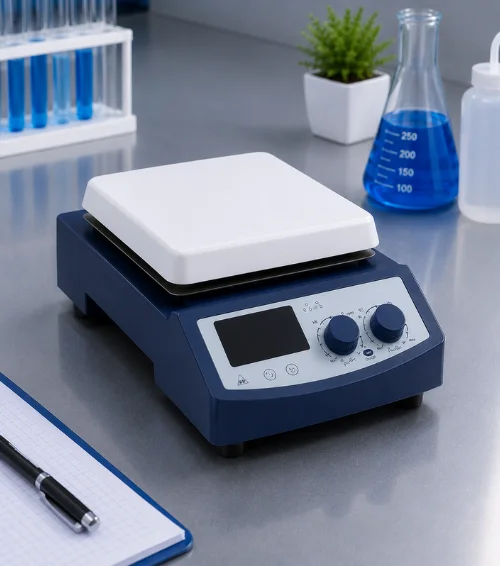
Choosing a magnetic stirrer is not simply about finding a machine with a high speed or low price. For laboratories, the right equipment should match the sample volume, liquid type, mixing speed, heating requirement and daily workload. A suitable magnetic stirrer can make solution preparation easier and help laboratory staff maintain more consistent mixing during routine testing and research. This guide explains what to look for when selecting laboratory mixing equipment and how to choose a model that fits your actual application.
What Is a Magnetic Stirrer?
A magnetic stirrer is laboratory equipment used to mix liquids without manual stirring. It uses a rotating magnetic field to move a small magnetic stir bar placed inside a container. As the stir bar rotates, it creates movement within the liquid and helps achieve more uniform mixing.
Laboratories commonly use magnetic stirrers for:
- Solution preparation
- Reagent mixing
- Sample preparation
- Chemical testing
- Research experiments
- Quality-control procedures
- Pharmaceutical laboratory work
- Educational laboratory experiments
For example, a technician preparing a laboratory solution may need continuous mixing for several minutes. Instead of manually stirring the sample throughout the process, the technician can place a stir bar inside the vessel and set the required speed.
Why Is Choosing the Right Magnetic Stirrer Important?
Different laboratory applications require different mixing conditions. A small research sample may need a compact stirrer with precise speed control, while a chemical or pharmaceutical process may require higher capacity or controlled heating.
Before purchasing laboratory mixing equipment, consider:
- Required sample volume
- Type of liquid
- Liquid viscosity
- Required stirring speed
- Heating requirement
- Temperature range
- Vessel size
- Operating time
- Available bench space
- Frequency of use
Selecting equipment according to these factors helps prevent problems such as poor mixing, splashing, unstable stirring or insufficient heating.
Key Factors to Consider Before Buying a Magnetic Stirrer
1. Stirring Speed
Stirring speed directly affects how quickly the liquid moves. However, higher speed does not always mean better mixing.
Some samples require gentle stirring while others need faster movement. Adjustable speed control allows laboratory users to increase or decrease the stirring rate according to the application.
Starting at a moderate speed and gradually increasing it can also help reduce splashing and unnecessary movement of the sample.
2. Sample Capacity
Check the recommended stirring capacity before selecting a model.
A laboratory that regularly handles small sample volumes may not need equipment designed for large containers. Similarly, larger sample volumes require a stirrer that can provide suitable magnetic movement across the vessel.
Always compare the manufacturer's recommended capacity with your actual working requirements.
3. Liquid Viscosity
The type of liquid also affects stirring performance.
Low-viscosity liquids are generally easier to mix with a magnetic stir bar. Thicker liquids may require stronger mixing or a different type of laboratory mixer.
If your application involves viscous materials, share the liquid type and approximate viscosity with the supplier before purchasing. This helps the supplier recommend equipment that better suits the process.
4. Heating Requirement
Some laboratory procedures require mixing and heating at the same time. In such cases, a magnetic hot plate stirrer can provide both functions in one instrument.
A Magnetic Hot Plate Stirrer Manufacturer in Mumbai can help laboratories select a suitable model based on heating temperature, sample size and stirring requirements.
For example, during solution preparation, a laboratory may need to keep a liquid moving while gradually increasing its temperature. A combined heating and stirring system can make this process more convenient and reduce the need for separate equipment.
5. Temperature Control
Temperature control becomes important when the laboratory process depends on a specific temperature.
A Temperature-controlled magnetic stirrer can help users manage heating while maintaining controlled stirring. When evaluating a heated model, look at the available temperature range, control system and method used to monitor temperature.
Do not select a model only because it has a high maximum temperature. The more important question is whether it provides the control required for your actual laboratory procedure.
6. Heating Surface
For heated magnetic stirrers, the working surface deserves attention.
Laboratories often work with chemicals and solutions that may spill during routine operations. A suitable working surface should be practical for regular laboratory use and easy to clean according to the manufacturer's instructions.
Ask about the surface material and its suitability for your working conditions before making a purchase.
7. Controls and Display
Simple controls can make daily laboratory work easier.
Depending on the model, magnetic stirrers may offer analogue or digital controls for speed and temperature. A clear display can help users monitor settings without repeatedly interrupting the process.
This is particularly useful in laboratories where different technicians or researchers operate the same equipment.
Magnetic Stirrer or Magnetic Hot Plate Stirrer?
The choice depends on your process.
A standard magnetic stirrer focuses mainly on liquid mixing. A magnetic hot plate stirrer combines mixing with heating.
If your laboratory only needs controlled liquid mixing, a standard magnetic stirrer may be sufficient. If the procedure requires heating and stirring together, a hot plate model may offer greater convenience.
For instance, consider a chemistry laboratory preparing a solution that needs continuous stirring while reaching a specific temperature. Using separate equipment can require more bench space and additional handling. A combined stirrer can simplify this workflow.
Applications of Magnetic Stirrers
Magnetic stirrers support many laboratory and industrial applications.
Pharmaceutical Laboratories
Pharmaceutical laboratories may use magnetic stirrers during solution preparation, formulation development, research and sample handling. Consistent mixing can help technicians follow repeatable laboratory procedures.
Chemical Laboratories
Chemical laboratories use magnetic stirrers for reagent preparation, solution mixing and research procedures where controlled agitation is required.
Research and Development
Researchers often need to adjust mixing conditions during experiments. Adjustable stirring speed allows them to change the process according to the sample and experimental requirement.
Educational Institutions
Colleges and universities can use magnetic stirrers for chemistry practicals, demonstrations and laboratory training. Easy operation makes them suitable for shared laboratory environments.
Quality Control Laboratories
Quality-control laboratories depend on consistent sample preparation. Controlled mixing can help technicians follow the same procedure across different samples.
Food and Environmental Testing
Food and environmental laboratories may use laboratory stirrers during sample preparation and testing procedures involving liquids and solutions.
What Should You Expect From a Magnetic Stirrer Manufacturer?
When searching for a Magnetic Stirrer Manufacturer in Mumbai, do not compare products only by price.
A reliable manufacturer should provide clear product information and help buyers understand whether a particular model suits their application.
Before purchasing, check for:
- Clear technical specifications
- Stirring capacity information
- Speed range
- Heating specifications
- Temperature-control details
- Operating instructions
- Product documentation
- Warranty information
- Technical assistance
- After-sales support
A good manufacturer should also ask about your application.
For example, if you need to mix a specific volume of liquid while heating it for a fixed period, the supplier should consider those requirements before recommending a model.
What Is Precision Magnetic Stirring?
Precision does not simply mean achieving a very high stirring speed.
A Reliable Hollow Cathode Lamps should provide controlled and consistent mixing for the intended laboratory application.
Actual mixing performance can also depend on:
- Stir bar size
- Vessel shape
- Sample volume
- Liquid viscosity
- Stirring speed
- Sample temperature
- Mixing duration
For example, placing a small stir bar inside a large vessel may not provide the desired movement even if the magnetic stirrer has a strong magnetic system.
The instrument and accessories should therefore match the application.
Common Magnetic Stirrer Buying Mistakes
Choosing Only by Price
A low-cost model may not provide the capacity or controls required for regular laboratory work.
Selecting the Highest Speed
Maximum speed is not automatically the right speed. Different samples require different mixing conditions.
Ignoring Liquid Viscosity
A stirrer suitable for thin liquids may not perform as expected with thicker materials.
Buying Heating Without a Need
If your laboratory only needs mixing, a heated model may add unnecessary cost and features.
Ignoring Vessel Size
The vessel should suit the recommended working area and capacity of the equipment.
Not Checking Support
Warranty, documentation and technical support can become important when the equipment is used regularly.
How to Use a Magnetic Stirrer Effectively
Good operating practices can help maintain consistent performance.
Start with a suitable stir bar and place the vessel correctly on the stirring surface. Begin at a lower speed and increase it gradually until you achieve the required mixing action.
Avoid immediately using maximum speed. Excessive speed can cause splashing or make the stir bar unstable.
If the stir bar stops rotating or moves irregularly, reduce the speed and check the vessel, stir bar and sample conditions.
For heated models, follow the manufacturer's instructions and monitor temperature according to the laboratory procedure.
Magnetic Stirrer Maintenance Tips
Regular care can help keep laboratory equipment in good working condition.
Follow these simple practices:
- Clean liquid spills promptly.
- Remove chemical residue from the working surface.
- Keep the equipment dry where required.
- Check the power cable regularly.
- Inspect controls for unusual operation.
- Clean the stir bar after use.
- Avoid exceeding recommended capacity.
- Follow the manufacturer's cleaning instructions.
- Arrange technical service if unusual noise or unstable operation develops.
If heating becomes inconsistent or the stir bar repeatedly loses rotation, investigate the issue instead of continuing to operate the equipment under unsuitable conditions.
How to Select the Right Magnetic Stirrer for Your Laboratory
Before contacting a manufacturer or supplier, identify your actual requirements.
Ask:
What type of liquid will we mix?
What volume will we normally handle?
Is the liquid thick or thin?
Do we need heating?
What temperature do we require?
What stirring speed range is suitable?
What type and size of vessel will we use?
How many hours will the equipment operate each day?
Do we need digital controls?
Will multiple laboratory users operate the equipment?
Clear answers to these questions make product selection easier and help suppliers recommend a more suitable model.
Why Choose the Right Laboratory Mixing Equipment?
The right equipment can simplify routine work and help laboratory staff maintain a more consistent process.
Instead of selecting a magnetic stirrer based only on its appearance or advertised speed, laboratories should consider the complete application. Sample volume, viscosity, heating requirements, vessel size and operating time all influence the choice.
For pharmaceutical companies, chemical laboratories, research centres, educational institutions and quality-control facilities, choosing equipment that fits the actual process can improve day-to-day usability and reduce the risk of selecting an unsuitable instrument.
Final Thoughts
A magnetic stirrer is a practical tool for laboratories that need controlled and repeatable liquid mixing. However, the right model depends on the application rather than one universal specification.
Before purchasing, compare sample volume, liquid viscosity, stirring speed, heating needs, temperature requirements and vessel size. If you need both heating and mixing, consider a magnetic hot plate stirrer. If you only need liquid mixing, a standard magnetic stirrer may be enough.
When comparing a Laboratory Cuvettes Stirrer Manufacturer in Mumbai, look for clear specifications, application-based guidance, product support and equipment that matches your laboratory's real requirements.
MxRady Lab Solutions Pvt. Ltd. provides KERRO Magnetic Stirrers for laboratory and research applications. Contact the team to discuss your mixing requirements and identify a suitable solution for your laboratory workflow.